Winter Calling: A Baxter Story
My husband and I have always loved winter, or, to be more honest, we love winter when there is snow. The kind that softens the noise and makes you feel like you’re stepping into something untouched. When we moved to the coast of Maine in 2020, buying my parents home and settling into a new rhythm of life, we thought we knew Maine pretty well. After all, we’d spent years visiting my parents and sisters, adventuring around the state. We took two trips into Baxter in the winter and two in the summer during those years, each carving its own place in our memory.
When the sign‑up date for winter camping in Baxter rolled around in 2025, it felt like a quiet invitation, a tap. We looked at each other, and the decision was made before either of us said a word.
And then there was the pulk.
Our son and daughter-in-law had built it for us, a sturdy, thoughtful gift that sat in the corner of the garage like a gentle reminder. Every time we walked by it, it seemed to whisper, Well? Are we going or not? It was the kind of gift that carries both love and expectation, and we felt both every time we saw it.
So we signed up. We packed. We dusted off our winter muscles and our sense of adventure. We headed north toward Baxter once again, toward the snow we love, the quiet we crave, and the part of ourselves that only seems to wake up in the deep of winter.
As we packed for the trip, my husband, the engine, the horsepower, kept reminding me to pack light. He said it the way only someone who’s about to haul the whole operation across miles of snow can say it: gently, but with meaning. I’d hold up a sweater or an extra pair of socks, and he’d give me that look, the one that says, Do you really need that?
And of course, I’d insist I did… until I didn’t. Because the truth is, when you’re heading into Baxter in winter, every ounce counts, and he was the one who’d feel every single one of them.
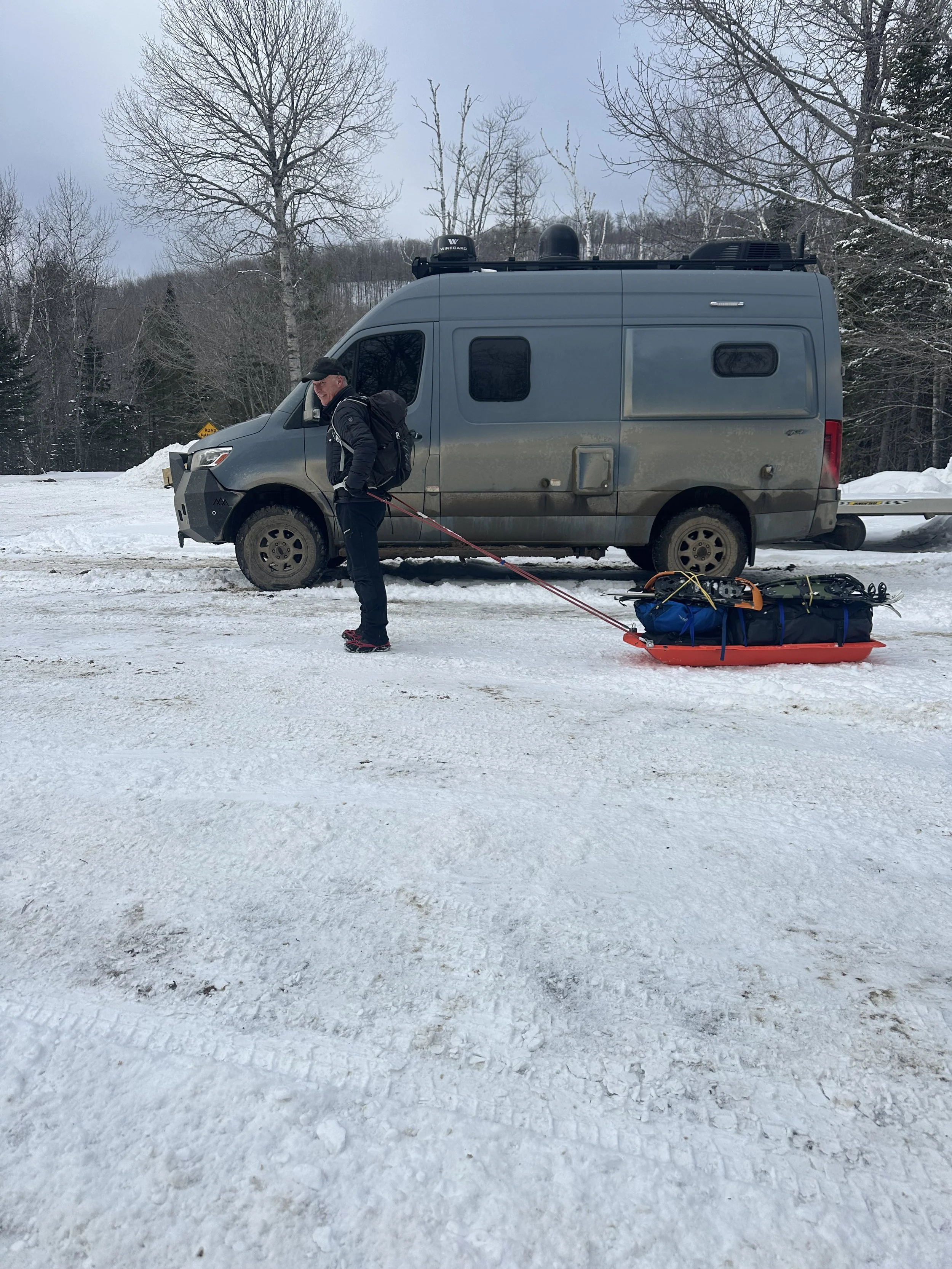
With only two sets of clothes, extra socks, emergency gear, and most importantly, FOOD, we started loading the pulk. It’s funny how quickly priorities sort themselves out when you’re packing for winter in Baxter. Clothing becomes negotiable. Comfort becomes optional. But food? Food is sacred.
We stacked meals and snacks like we were preparing for a small expedition, which, in a way, we were. My husband would glance at the growing pile, then at me, then back at the pile, as if trying to calculate the exact moment when “pack light” had officially left the conversation. But even he didn’t argue with the food. He knows better.
By the time we zipped the last bag and cinched the straps tight, the pulk looked ready.
We’ve eaten plenty of dehydrated meals over the years, some surprisingly good, some… character‑building. But lately I’ve been on a mission to get as much junk and as many chemicals out of my body as possible. So bringing homemade food felt important this time. If I were going to spend days in the quiet of Baxter, I wanted real nourishment, not something that tasted like it had been freeze-dried.
And then there was the chili.
A few days before our trip, I’d won a local chili cook-off, a small victory, but one I was still riding high on. So, of course, the chili had to come along. How could it not? It felt like bringing a little piece of home, a little celebration, a little warmth in a pot. My husband raised an eyebrow when he saw me packing it, the kind of look that said, This is not light, but he didn’t say a word. You don’t argue with a woman who just won a chili competition.
So into the pulk it went, the clothes, the socks, the emergency gear, the sacred stash of food, and the champion chili all tucked in and ready for the miles ahead.
Let me just say this: in our minds, this trip was going to be easier than our previous winter treks into the park. Easy for me to say, I’m not the horse. My husband was the one pulling the pulk, after all, and I was the one cheerfully imagining a breezy little five-mile stroll to Trout Brook Campground.
Five miles felt downright civilized compared to our earlier winter trips to South Branch Pond, which were more than double the distance and had left us with stories we still tell and muscles we still remember. So this time around, we convinced ourselves it would be a lighter lift. A gentler adventure. A “we’ve got this” kind of trip.
But winter in Baxter has a way of reminding you that distance on a map is only part of the story. Snow depth, trail conditions, temperature, wind, they all get a vote. Still, with the pulk packed, the chili secured, and our optimism fully inflated, we set off believing this would be the easy one.
At least, that’s what we told ourselves.
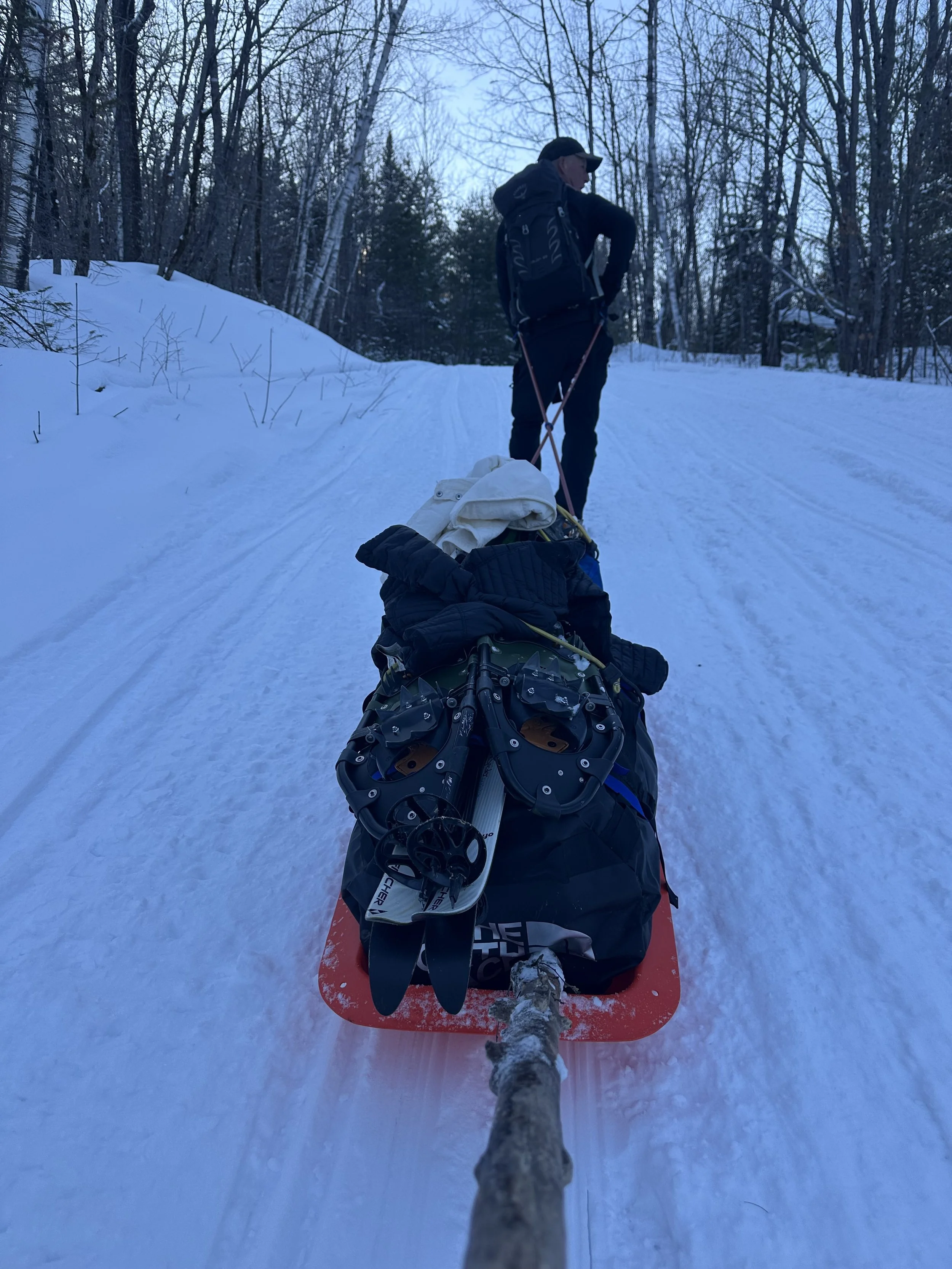
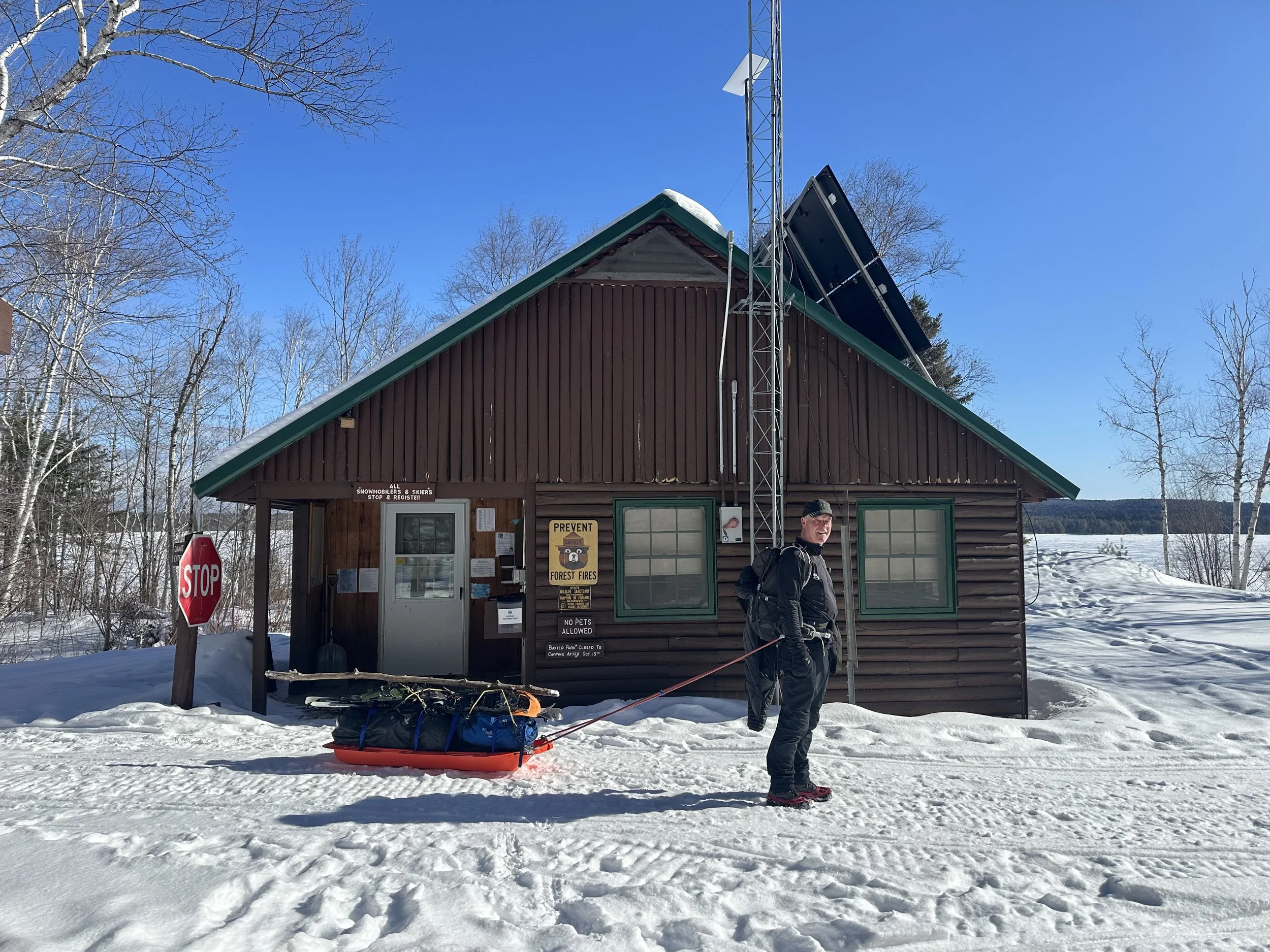
The conditions were amazing, perfect for skiing, snowmobiling, and snowshoeing. The pulk, on the other hand, had a very different experience. Ours has metal plates screwed into the bottom to help keep it tracking straight, and on hard-packed snow, it glides beautifully. But this winter, the first in many years with that light, puffy, cold-weather snow, there was no glide to be found. The pulk tracked fine; it just dug in, sinking into the powder like it was trying to burrow its way to spring. Every step forward felt like my husband was dragging a stubborn anchor.
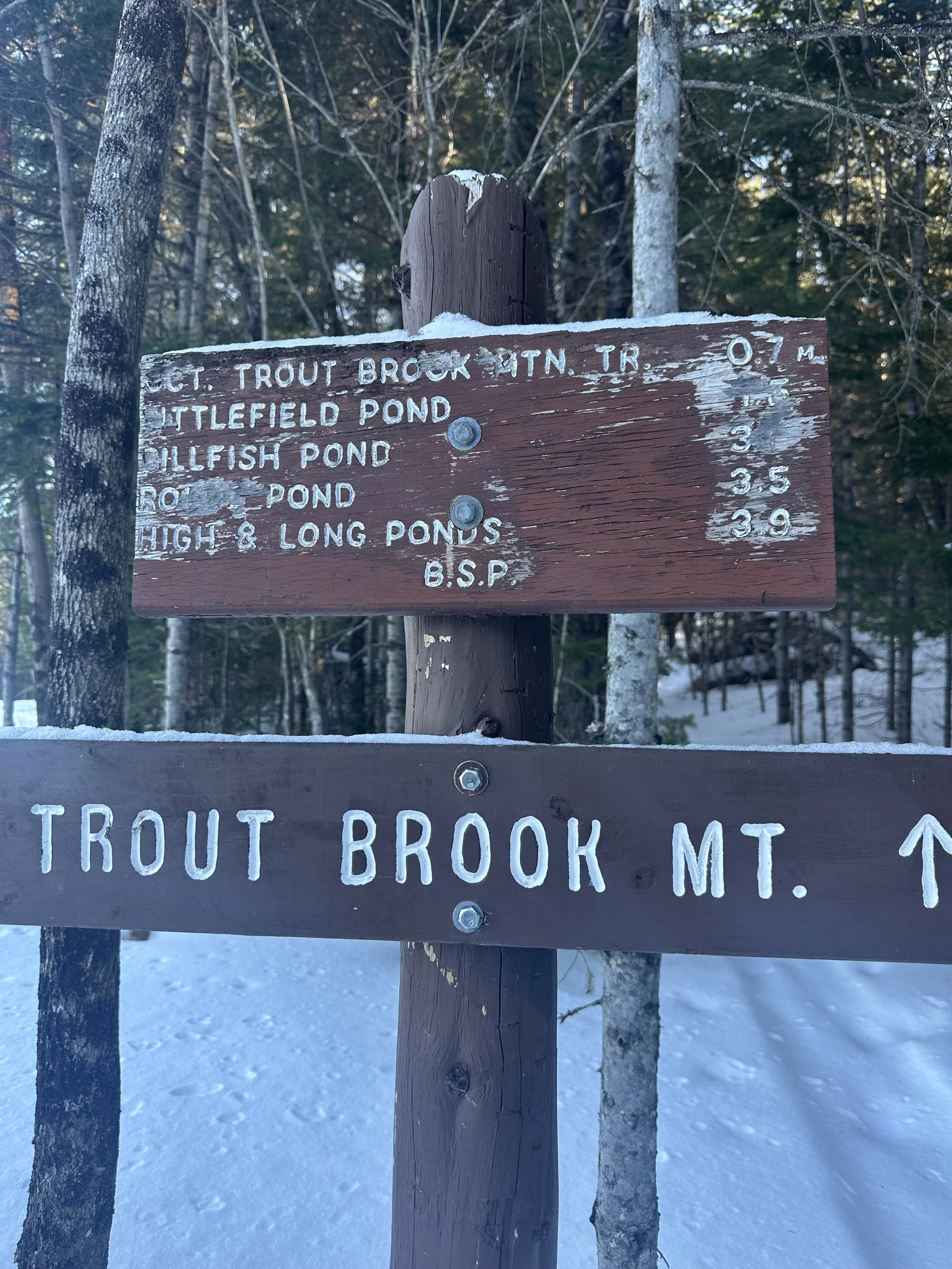
On the steeper hills, I tried to help by pushing from behind with a big stick I found along the trail. It wasn’t elegant, but it worked, the two of us moving in this slow, determined rhythm, him pulling, me pushing. Every time we reached the top of a rise, sometimes before, he’d stop, we would catch our breath, and scan the trail ahead, watching around every bend for the Trout Brook Farm Campground sign.
Those breaks became their own little moments, the quiet settling around us, our breath hanging in the cold air, the snow muffling everything except our own breath. Each time he looked ahead, I could see the mix of hope and calculation on his face, like the sign might magically appear if he stared hard enough. And honestly, I was looking for it too. Five miles in Baxter can feel like three or like ten, depending on the snow, the weight, and the mood of the day.
But we kept going, knowing that somewhere up ahead, that sign was waiting for us.
The sun had set, and that beautiful but fleeting evening light settled over the forest, the kind that makes everything feel closer, quieter, like the woods are gently folding in around you. With every bend in the trail, those hopeful thoughts of finally seeing the Trout Brook Farm Campground sign came more and more often. We were tired, the pulk was heavy, and the snow was deep. Hope becomes a kind of fuel in moments like that.
And then, finally, we were there.
We had a map of the campground, but once we actually arrived, we realized something important: we had no idea where the bunkhouse really was. The map gave us the general layout, sure, but in the dimming light, with everything buried under a generous layer of snow, it might as well have been a sketch of the moon.
Trying not to get too excited or too panicked, we put on our headlamps. The map wasn’t much help, and there was a lot of snow. In the past, rangers had packed down a path to the bunkhouse, a little winter gift we’d come to appreciate. But not this time. This time, it looked like we’d be breaking trail through deep snow, wandering around in the dark trying to find a building that could be anywhere.
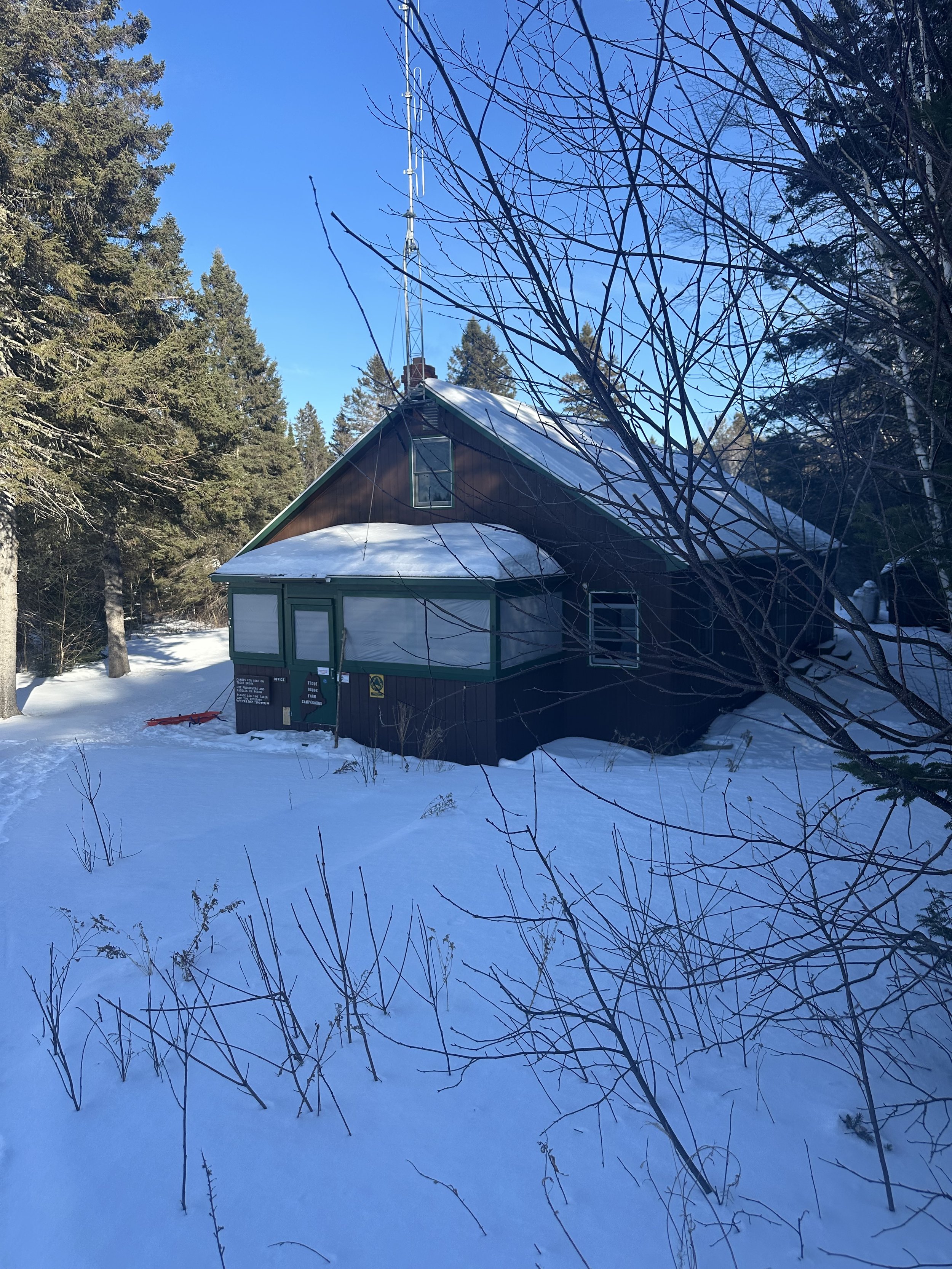
The first structure we came to was on the right, the check-in building. Nothing on the outside told us anything useful, but it had a porch, and at that moment, a porch felt like a small miracle. We stepped inside, brushed off the snow, and found all kinds of posted information. But most importantly, we found two doors.
One to the ranger’s office.
And one to the bunkhouse.
Just like that, the whole world shifted from uncertainty to relief, from wandering to arrival. We’d made it.
Relieved to have found our home away from home, we began the familiar routine of unpacking, starting a fire, and poking around to see what we were working with. After a little while, the cabin warmed up, we changed into dry clothes, and heated up, yes, some chili. There is nothing quite like eating something homemade and hot after a long winter haul. It tasted even better knowing it had won a cook‑off just days before.
Because it was already dark, we decided to use the water we’d carried in our packs and then melt and boil snow for the rest of what we needed that night. We’d done this twice before at South Branch Pond, so we had a pretty good idea of the routine. Gas lights, a pile of wood, bunk beds, a table — simple, predictable comforts. And those little woodstoves they provide? They absolutely do the job. They’re basic, straightforward, and wonderfully effective. The downside, of course, is that “effective” can quickly turn into “out of control” if you’re not paying attention.
And that first night… well, it was something else.
Both of our sleeping pads were terrible, neither one holding air, and we were almost ten years older than the last time we’d slept on a hard surface. Our bodies made their opinions known immediately. But the real adventure was the heat. The only way to regulate the temperature in those cabins is to open a window or two. We opened none. Not a single one. Maybe we were too tired, maybe too lazy, maybe just too relieved to be inside, but whatever the reason, we paid for it.
Holy mother of God, it was a sauna in there.
I sleep at home all winter with my window cracked, so this was… a lot. The kind of heat that makes you question your life choices. The kind that has you peeling off layers you didn’t even know you were wearing. We knew better we absolutely knew better.
Still, even in the sweltering heat, even on half‑deflated pads, there was something comforting about being tucked into that little cabin in the middle of Baxter. We were there. We’d made it. And the adventure was only just beginning.
The next morning we started our day with homemade Blueberry Breakfast Cake warmed on the woodstove, instant coffee, boiled snow, and blue skies. There’s something about that first morning in a winter cabin, the quiet, the slow warmth of the stove, the smell of coffee mixing with woodsmoke, that makes everything feel unhurried. We let ourselves have a leisurely start, reading, melting and boiling snow, and soaking in the peace that only Baxter in winter can offer.
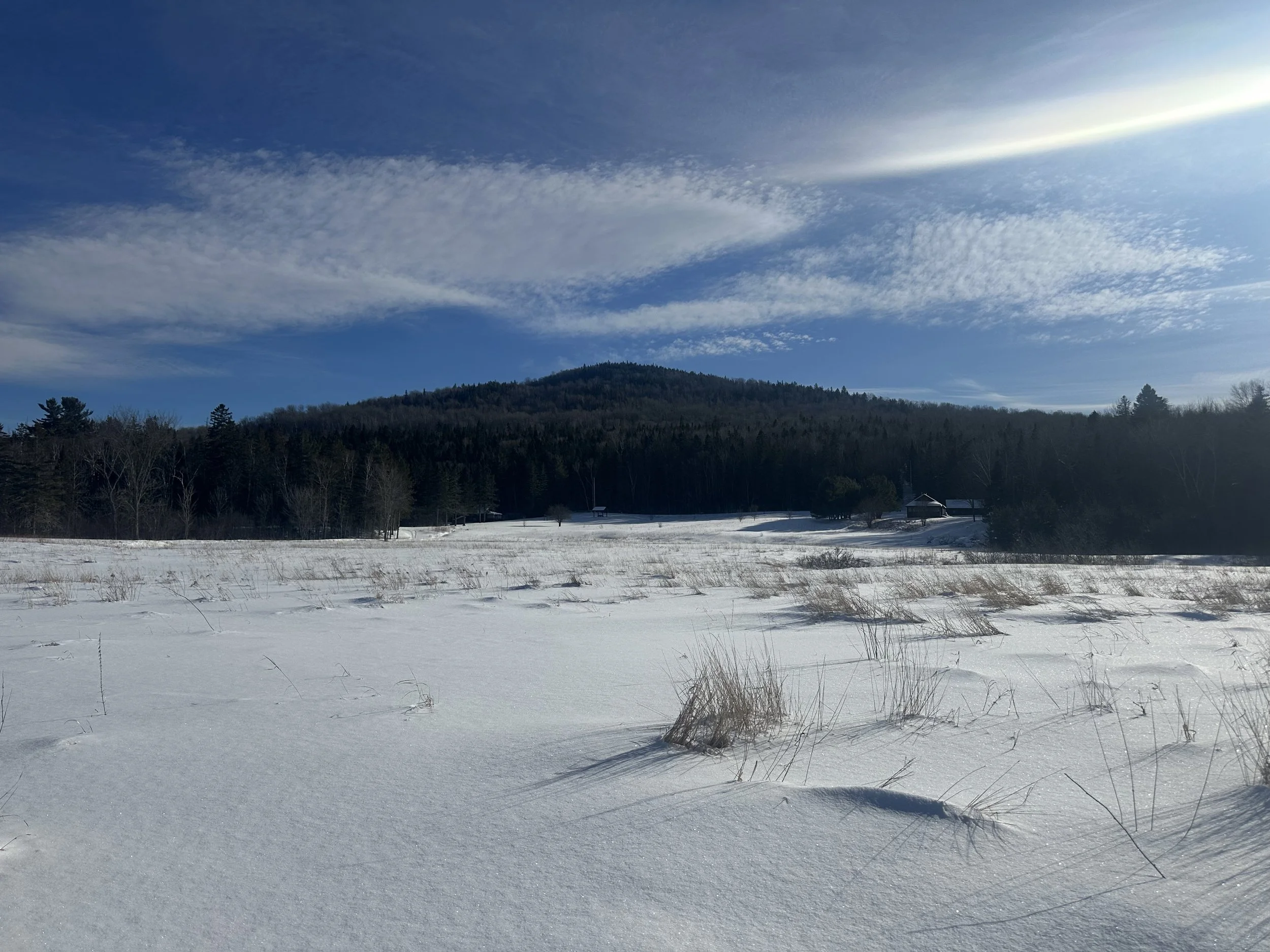
After a while, we decided to go exploring, looking for water sources and getting a lay of the land. Even under a deep blanket of snow, the place was incredibly beautiful. In fact, the snow almost made it more magical, like seeing the campground in its most secret form. It made me want to come back in the summer just to compare the two versions of the same place.
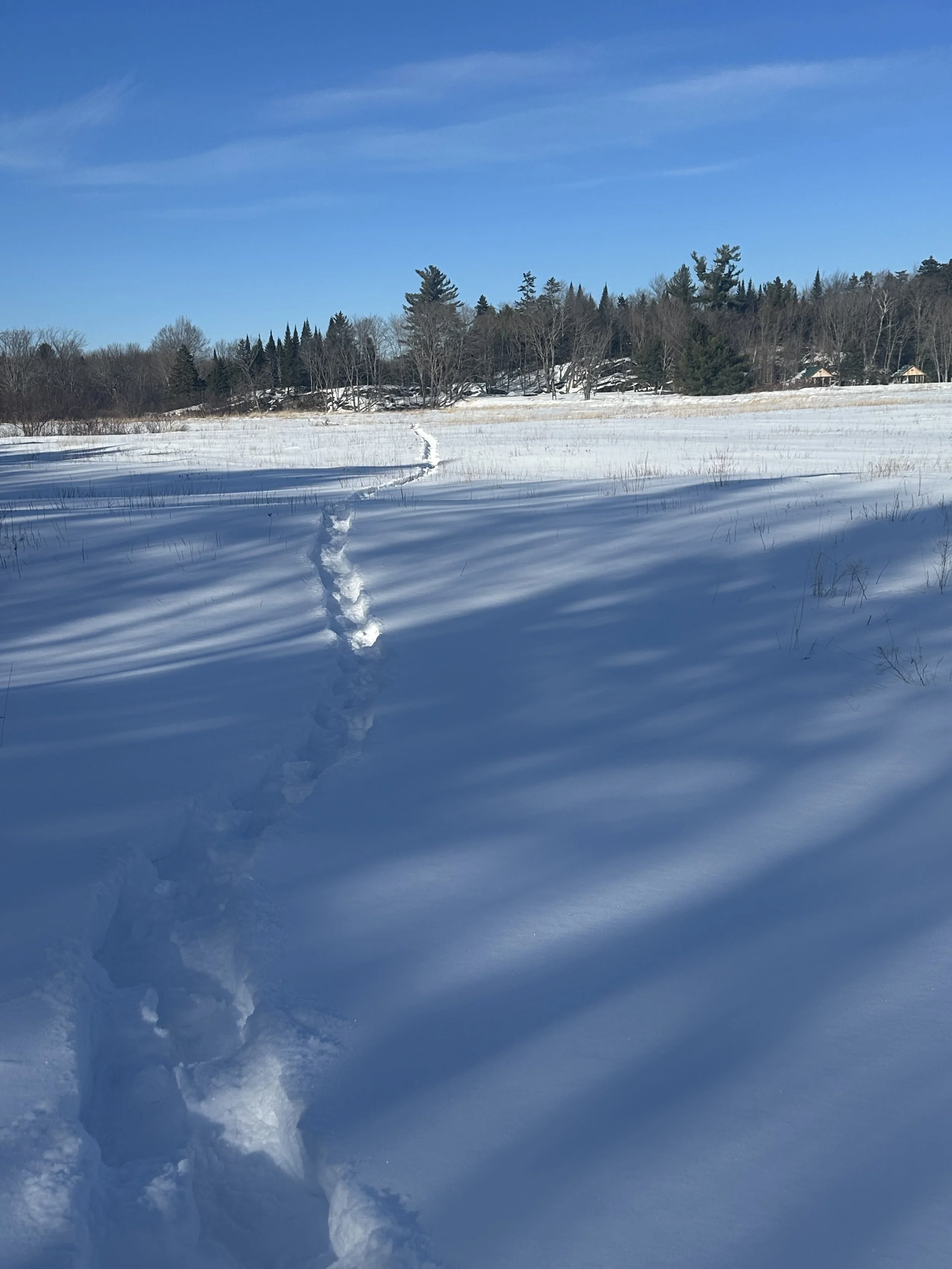
We walked down to Trout Brook, but the only open water was on the far side, and the bridge across was closed. So we wandered the perimeter of the campground instead, noticing the different animal tracks across the snow: moose, deer, fox, mice.
We snowshoed the perimeter road a bit and checked out a couple of trailheads for the next day. The air was crisp, the sky was clear, and the whole place felt like we had it entirely to ourselves.
It was one of those mornings where nothing dramatic happens, but everything feels exactly right.
Back at the bunkhouse, with the light fading again, we settled into our evening routine, preparing dinner, melting and boiling snow for water, tending the fire, and getting ourselves ready for an early night. There’s something about winter camping that makes the old rhythms feel obvious again. Isn’t it true that our bodies are meant to sleep when the sun sets and wake with the sunrise? You feel it so clearly out there, without clocks or screens or streetlights to argue otherwise.
Dinner that night was Beef Bolognese with homemade pasta, a far cry from the dehydrated meals we’ve choked down on past trips. We followed it with herbal tea and homemade Chocolate Chip Cookie Bars, letting the warmth settle into our bones. By 7:00 p.m., we were in bed, the kind of early bedtime that feels completely natural when the world outside is dark and silent.
This time, we had the fire‑and‑window situation under control. We cracked a window, kept the stove at a steady burn, and managed to avoid turning the bunkhouse into a sauna. Even without a cushion or a sleeping pad that held air, we slept so much better. The bunks were still hard, our hips still protested, but the temperature was right, the air was fresh, and the quiet wrapped around us like a blanket.
It was the kind of night that reminds you why you came, simple, peaceful, and exactly what winter in Baxter is meant to be.
The next morning, we had an oatmeal breakfast with dried fruit, and you guessed it, more Blueberry Breakfast Cake. My husband joked that we might come out of the woods fifteen pounds heavier, but at least the extra weight wouldn’t be on the pulk. He wasn’t wrong.
We tidied up the cabin, did a little reading, and ended up learning quite a bit about Baxter State Park, how it came to be, the naming of Katahdin, and the early history. It’s funny how you can visit a place for years and still discover something new about it when you finally slow down long enough.
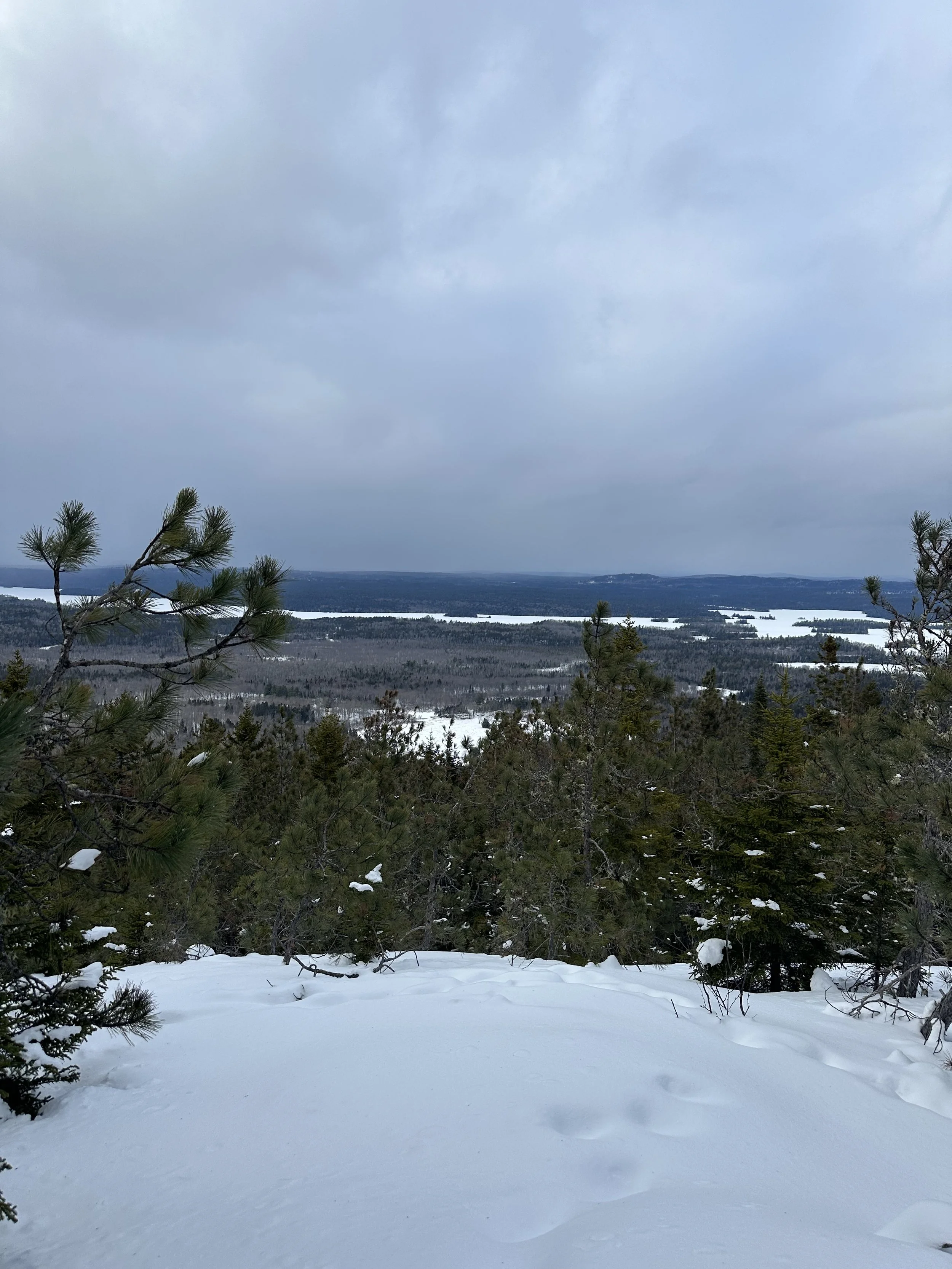
But the day was too beautiful to stay inside. We wanted to get out and either ski or hike, and we settled on a hike up Trout Brook Mountain. My husband broke trail the whole way, just like he always does. The deep snow reminded us of our very first winter trip to South Branch Pond, so much snow, so much falling and laughing, the two of us loving the adventure even when it was hard.
On the way back down, we saw more signs of life, moose tracks and scat, rabbit tracks, coyote, and fox. It felt like the whole forest had been busy while we were tucked away in our little cabin.
Back at the bunkhouse, we slipped right back into our evening ritual: melting and boiling snow, heating dinner, settling into the quiet. That night’s meal was mac and cheese with ground turkey, followed by more Chocolate Chip Cookie Bars. We read until the light faded too much to make out the words, the kind of natural ending to a day that only happens when you’re living by the sun instead of the clock.
It was simple, peaceful, and exactly the kind of day we come to Baxter for.
Our last morning… I never quite know how to explain that feeling except to say we were torn. We love the simplicity, the quiet, the way life shrinks down to warmth, food, snow, and each other. But we also missed our pups. And our mattress. Honestly, the mattress might have been calling louder than anything else.
We had no reason to rush. Plenty of time, plenty of daylight, and no schedule except our own. We finished the remaining breakfast cake, made coffee, tidied up the cabin, and slowly began packing. It was sad to be leaving, probably more so for my husband, knowing exactly what the next five-plus miles were going to demand of him.
The day was cold, around ten degrees, which actually helped the pulk glide better. We walked along, following the tracks of a fox almost the entire way out. I would’ve given anything to see him, just a glimpse, but the tracks were their own kind of gift, a reminder that the forest is always awake, always watching.
It was another blue-sky day, the kind that makes winter feel endless in the best way. We saw just a few snowmobiles on the perimeter road, and before we knew it, the van came into view. At that moment, the mix of relief, accomplishment, and a tiny bit of sadness is always the same.
We loaded up and began the three-hour drive home, but not without a detour to East Millinocket for a beer and a burger at a little pub, and saw some views of Katahdin on the way. It felt like the right way to close the trip: warm food, cold beer, tired bodies, and that mountain watching over everything.
I’m so happy we did this trip again. We will be back. We’re both in our sixties now, some of us with new body parts and accessories, haha, but we don’t let that stop us. We keep going, keep adventuring, keep seeing what Maine and the rest of this incredible country have to show us.
Because there’s still so much to see. And we’re not done yet.
Rick and Teresa Crowe
Owls Head Maine